
How to Choose the Right Composite Decking Colour for Your Garden


You've decided on composite decking. The budget is worked out, the garden measured, and maybe you've already had a quote. Then comes the moment that trips most homeowners up: staring at the colour range and wondering how on earth to choose.
This composite decking colour guide is written for UK homeowners who want a practical way to make that decision — not a list of trends, but a clear framework based on how your garden actually looks and works. Whether you're considering Millboard, Trex, or NewTechWood, the same principles apply.
Start With Your Home, Not a Trend
The most reliable starting point is the building itself. Look at the tone of your brickwork, render, or cladding. Warm reddish brick sits far more naturally with warm honey or oak tones than a cool slate grey that clashes with the masonry. The same logic applies to your window frames, front door colour, and any existing garden structures like fencing or pergolas.
Composite decking doesn't need to match everything exactly — but it should feel like it belongs. If you already have a colour scheme working in your garden, build on it rather than introducing something entirely new. Think of the decking as a large fixed element in the overall composition, more like a floor covering than an accessory you can easily swap out.
How Much Sunlight Does Your Garden Get?
This is one of the most practical questions to ask before choosing a colour — and one that many homeowners overlook until after installation. Dark boards absorb more heat and can become noticeably warm underfoot on sunny summer afternoons. In a shaded or north-facing garden that's fine, but in a south-facing garden that gets full sun from June to August, a very dark board is worth thinking twice about.
Lighter boards reflect more heat but show surface dust, pollen, and debris more visibly — particularly in dry weather or under overhanging trees. A mid-tone board is often the most forgiving choice: less heat than a dark board, less visible surface mess than a pale one. If you're unsure, your installer may be able to help advise on which tones perform best for your garden's orientation.
Coordinate With What's Already There
Most gardens have fixed elements you can't change: boundary fencing, rendered walls, outbuildings, or existing paving and patio materials. Before committing to a composite decking colour, photograph those elements and look at them together. You're not matching a paint chart — you're building a visual composition that will be lived in for decades.
Some combinations that consistently work well in UK gardens: cool grey boards with white or light render suit modern homes with a clean aesthetic; warm brown or oak tones alongside red brick feel grounded and natural, complementing traditional and period properties; charcoal boards paired with dark timber fencing create a bold contemporary scheme; and mid-tone greys sit comfortably with the widest range of house styles. The most useful thing you can do is get physical samples and look at them against your existing materials in natural daylight — colours look dramatically different on screen compared to a real UK garden.
Colour Options From Millboard, Trex and NewTechWood
At Duralive Decking, we mainly install three premium composite brands across Merseyside and Cheshire. Each has a distinct approach to colour and surface texture — and understanding those differences can help you choose the right board as well as the right shade.
Millboard
Millboard's colour range is built around capturing the natural variation of real timber. Their boards are hand-moulded from actual wood, so each plank has subtle surface differences that read as genuinely organic rather than manufactured. Colours include Weathered Oak, Smoked Oak, Limed Oak, Antique Oak, and Honey, all designed to deepen naturally in the first couple of years rather than fade uniformly. If authenticity of appearance is the priority, Millboard is hard to match. See the full colour range at millboard.co.uk.
Trex
Trex offers a wide palette across their product lines, from earthy naturals to cool greys and deep charcoals. Their capped composite technology protects colour with a hard outer shell, significantly reducing the fading and surface staining that older uncapped composites were known for. Trex is one of the most widely tested composite decking brands in the world, with strong long-term colour stability and upto 50-year residential warranty on certain products. Explore their colour range at trex.com.
NewTechWood
NewTechWood's Naturale Range takes a bolder approach. The boards are fully capped with a distinctive embossed grain and available in strong tones including teak, Walnut, light grey, antique and ebony black. For gardens with a confident, contemporary design brief, NewTechWood delivers some of the most vibrant and consistent colour payoff of the three brands, while still carrying eco-conscious credentials across the range.
Getting Creative: Patterns, Two-Tone Designs and Accent Edges
A single, well-chosen board colour is enough for most decks, but it isn't the only option. On larger spaces, multi-zone gardens, and projects where the deck is intended to feel like a designed feature rather than a flat platform, patterns and two-tone layouts can transform how the finished space reads.
Patterned decking with Millboard Modello
For pattern work specifically, Millboard Modello® sits in a category of its own. It is the only composite range we install that is purpose-engineered for pattern design — the same board is offset to create over 50 distinct configurations, opening up genuine creative scope without bespoke fabrication or complex subframe work.
Modello comes in two pattern styles:
Linear — clean geometric lines, suited to contemporary, architectural spaces
Contour — softer organic curves, ideal for gardens where you want flow rather than rigid geometry
Both styles can be installed three ways:
Across the full deck — a bold, design-led statement that turns the surface itself into the feature
As a feature inlay — a patterned panel set within plain boards, often used to mark out a dining area, an entrance threshold, or a key sight line
As a zonal divider — using a patterned section to define separate areas (lounge, dining, hot tub) within one continuous deck
Because Modello sits within the wider Millboard system, it pairs naturally with the rest of the range — meaning plain Enhanced Grain or Lasta-Grip® boards can be combined with patterned features in the same deck.
Two-tone decking on larger spaces
On larger decks — roughly 30m² and above — a single colour can start to feel flat. The eye has nothing to break it up, and the space reads as one continuous expanse rather than a deliberately designed area.
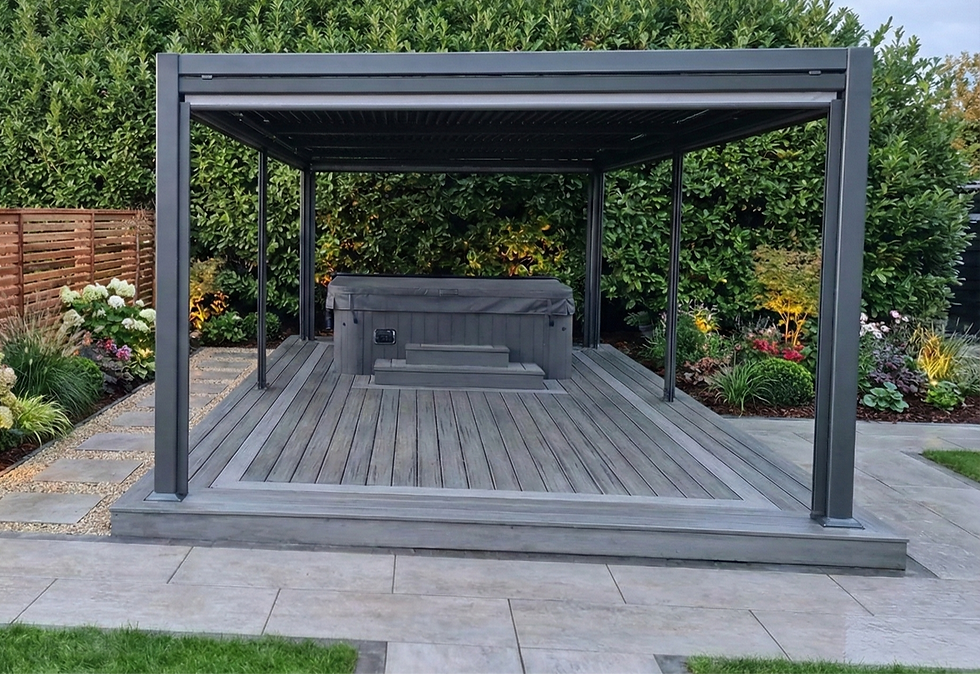
Two-tone layouts solve that. Two complementary board colours, arranged in defined zones or framed sections, add visual rhythm and quietly do the same job that rugs and zoning do inside a home. Common pairings include a darker frame around a lighter field, or two tonally close colours used to subtly differentiate a dining zone from a lounge zone.
The key word is complementary. High-contrast pairings — very pale grey against deep charcoal, for example — work well on contemporary schemes but can look busy in more traditional gardens. Two tones from the same family, such as coppered oak alongside antique oak, almost always work and are the safer brief for most domestic projects.
Accent edges and bullnose details
A simpler but consistently effective technique is to pick out perimeter edges and step nosings in an accent colour. Picture-framing the deck with a darker board, or running an accent bullnose along step treads, gives the finished installation a defined, intentional edge — the same principle as a skirting board running around a room.
For steps specifically, an accent bullnose isn't purely decorative. It visually marks each tread, which improves safety in low light and makes the step easier to read at a glance — particularly useful on multi-level decks where the step sits within a longer line of sight.
These are the details that separate a deck that looks installed from one that looks designed. None of them adds significant cost over a standard build, but each meaningfully changes how the finished space presents — and how it photographs.

Will the Colour Fade Over Time?
A common concern — and a fair one. Older composite boards had a reputation for fading quite dramatically in the first couple of years. Modern capped composite boards from premium brands are substantially more stable, but it's worth understanding what to expect.
All composite boards go through some degree of natural weathering in the first 6 to 18 months. The surface oxidises slightly and settles into its longer-term tone — typically a shade or two lighter than on installation day. This is by design: that settled colour is the one engineered to remain stable for the life of the board, which is 25 years or more with premium brands. Don't be alarmed if your deck looks slightly different in its second summer. From that point it should remain consistent, especially with regular cleaning to prevent algae or debris build-up.
Choosing the Right Composite Decking Colour: Your Next Steps
Before you commit to a composite decking colour, get physical samples and spend time with them in your garden. Look at them at different times of day — in full sun and in shade — and involve whoever you live with. Decking is a significant long-term investment, and taking an extra week to feel confident about the colour is always worthwhile.
Work through a few practical questions: Does this tone complement my brickwork or render? How much direct sun hits the deck in summer? Am I looking for something that blends in, or something that makes a visual statement? What will this look like alongside outdoor furniture, planters, and lighting? Once you have samples in hand and those questions answered, the right choice tends to become clear.
If you'd like expert guidance on composite decking colour selection, our team at Duralive Decking is happy to talk you through the options and bring samples to your property. Browse some of our past projects to see how different colours look in real Merseyside and Cheshire gardens, or get in touch to arrange a free, no-obligation consultation.


Comments