
Sustainable Decking in Merseyside & Cheshire: How Composite Boards Are Changing Outdoor Living


Sustainability has moved from being a nice-to-have to a real priority for UK homeowners. Whether it’s reducing maintenance, avoiding constant timber treatment, or choosing materials that last longer and perform better, more people are asking the same question:
“Is composite decking actually a more sustainable choice than timber?”
As specialist composite decking installers working across Merseyside and Cheshire, we’re seeing a clear shift. Homeowners want outdoor spaces that look good, last decades, and don’t come with the environmental or maintenance drawbacks of traditional materials.
In this guide, I’ll explain how modern composite decking boards are changing outdoor living in the UK — based on real-world installation experience, not marketing fluff.
What Do We Mean by “Sustainable Decking”?
When we talk about sustainable decking, we’re not just referring to recycled content. True sustainability is about the full lifecycle of the deck — from manufacture through installation, use, and long-term performance.
In practical terms, a sustainable decking solution should:
Last for decades without replacement
Require minimal chemical treatments or coatings
Reduce waste over its lifespan
Perform safely in the UK climate
Composite decking ticks these boxes when it’s specified and installed correctly.
How Composite Decking Is Different From Timber
Composite decking boards are manufactured using a blend of recycled plastics and wood fibres, creating a stable, engineered product designed specifically for outdoor use.
Unlike timber, composite boards:
Do not rot, split, or splinter
Are far more resistant to moisture and algae
Do not require annual staining, oiling, or sealing
Maintain colour and surface integrity far longer
From a sustainability point of view, the biggest advantage is longevity. A well-installed composite deck can easily last 25–30 years — far longer than most softwood decks, which often need major repairs or replacement within a decade. Read our blog on The Truth About Composite Decking Maintenance: What You Really Need to Do for more info about maintaining composite decking.
Real-World Installation Considerations That Matter
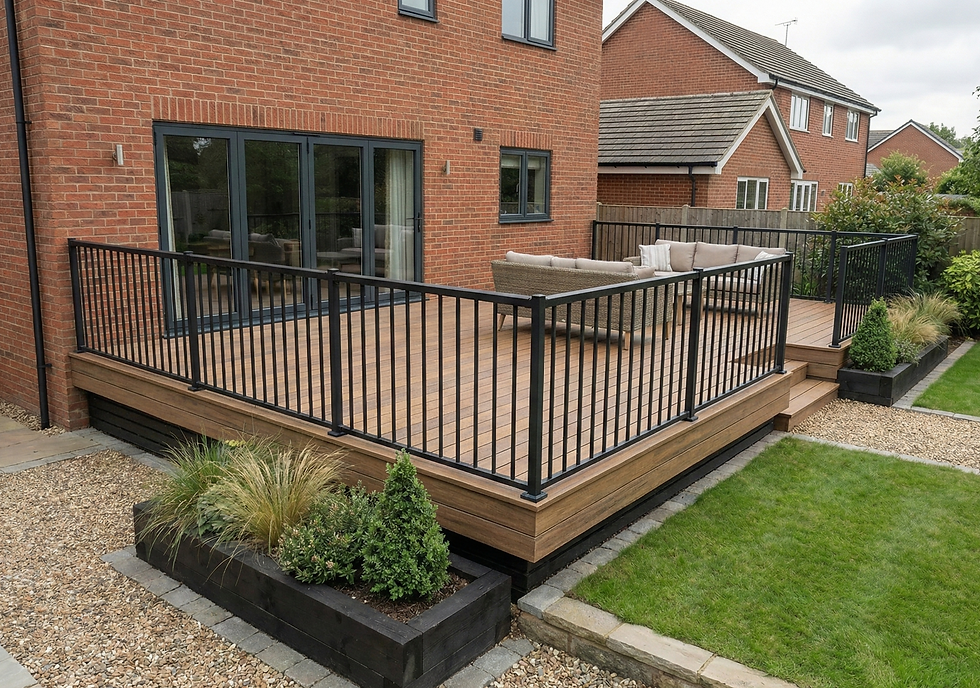
This is where sustainability often gets overlooked. Even the best eco decking boards will fail prematurely if the structure underneath isn’t right.
Structural Design & Load Performance
A sustainable deck must be structurally sound for its entire lifespan. That means:
Correct joist spacing based on the board manufacturer
Adequate fixing systems designed for composite movement
Load considerations for furniture, planters, and foot traffic
Professional design ensures the deck performs exactly as intended, year after year.
Drainage & Airflow (Often Ignored, Always Critical)
One of the biggest causes of premature deck failure is trapped moisture.
Good composite decking design always allows for:
Free drainage through the deck surface
Ventilation beneath the boards
Separation between ground, structure, and decking surface
This protects both the subframe and the boards, reducing mould growth and extending the life of the entire system.
Fixings & Subframe Materials
Sustainability isn’t just about the boards on top.
A properly specified deck will use:
Corrosion-resistant fixings
Treated timber or aluminium subframes suited to UK ground conditions
Manufacturer-approved clips or screws
Cutting corners here often leads to movement, noise, and early failure — none of which are sustainable.
Comparing Leading Composite Decking Systems
There’s no such thing as a “best” composite decking board — only the right product for the right project.
Mineral-based core with a moulded wood-grain surface
No wood fibre, so exceptional moisture resistance
Ideal for premium gardens and exposed locations
Capped composite boards using recycled plastics
Excellent balance of performance, appearance, and value
Strong choice for modern family gardens
One of the most established composite brands globally
High recycled content and proven long-term durability
Well suited to large decks and entertaining spaces
Each system has its place. Sustainability comes from correct specification, not just brand selection.
Common Mistakes Homeowners Make With “Eco” Decking
One of the biggest misconceptions is that all composite decking is sustainable simply because it contains recycled material.
In reality, problems arise when homeowners:
Choose cheap, unbranded composite boards
Ignore subframe and drainage requirements
Assume composite is “fit and forget” regardless of design
Install boards without following manufacturer guidance
Poor-quality composite can fade, warp, or delaminate — leading to early replacement and unnecessary waste.
Why Professional Design Makes a Sustainable Difference
A truly sustainable deck is designed, not just built.
Professional input ensures:
Efficient material use with minimal waste
Correct detailing around edges, steps, and drainage
Long-term performance without remedial work
At Duralive Decking, we approach every project as a long-term structure, not a short-term cosmetic upgrade. That mindset is what turns eco decking into a genuinely sustainable garden feature.
The Bigger Picture: Sustainable Garden Design
Composite decking fits naturally into wider sustainable garden design:
Reduced chemical use
Long service life
Compatibility with permeable drainage solutions
Low ongoing environmental impact
For homeowners in Merseyside and Cheshire, this means a garden that looks better for longer — with fewer hidden costs down the line.
Final Thoughts & Next Steps
Composite decking has fundamentally changed outdoor living in the UK. When designed and installed properly, it offers:
Long-term durability
Reduced maintenance
Responsible material use
A high-quality finish that lasts decades
If you’re considering eco decking or want honest advice on Millboard, NewTechWood, or Trex decking UK, we’re always happy to help.
👉 Get in touch with Duralive Decking to arrange a free design consultation and expert guidance for your home in Merseyside or Cheshire.


Comments